What Makes a Shaker Door ‘Modern’ vs. Traditional
A classic Shaker door is a five-piece assembly: two vertical stiles, two horizontal rails, and a flat recessed center panel. The traditional version tends toward wider rails (2.5 to 3 inches), softened inside edges, and warm stained oak or maple. The modern version keeps the same construction logic but changes the proportions and the finish language.
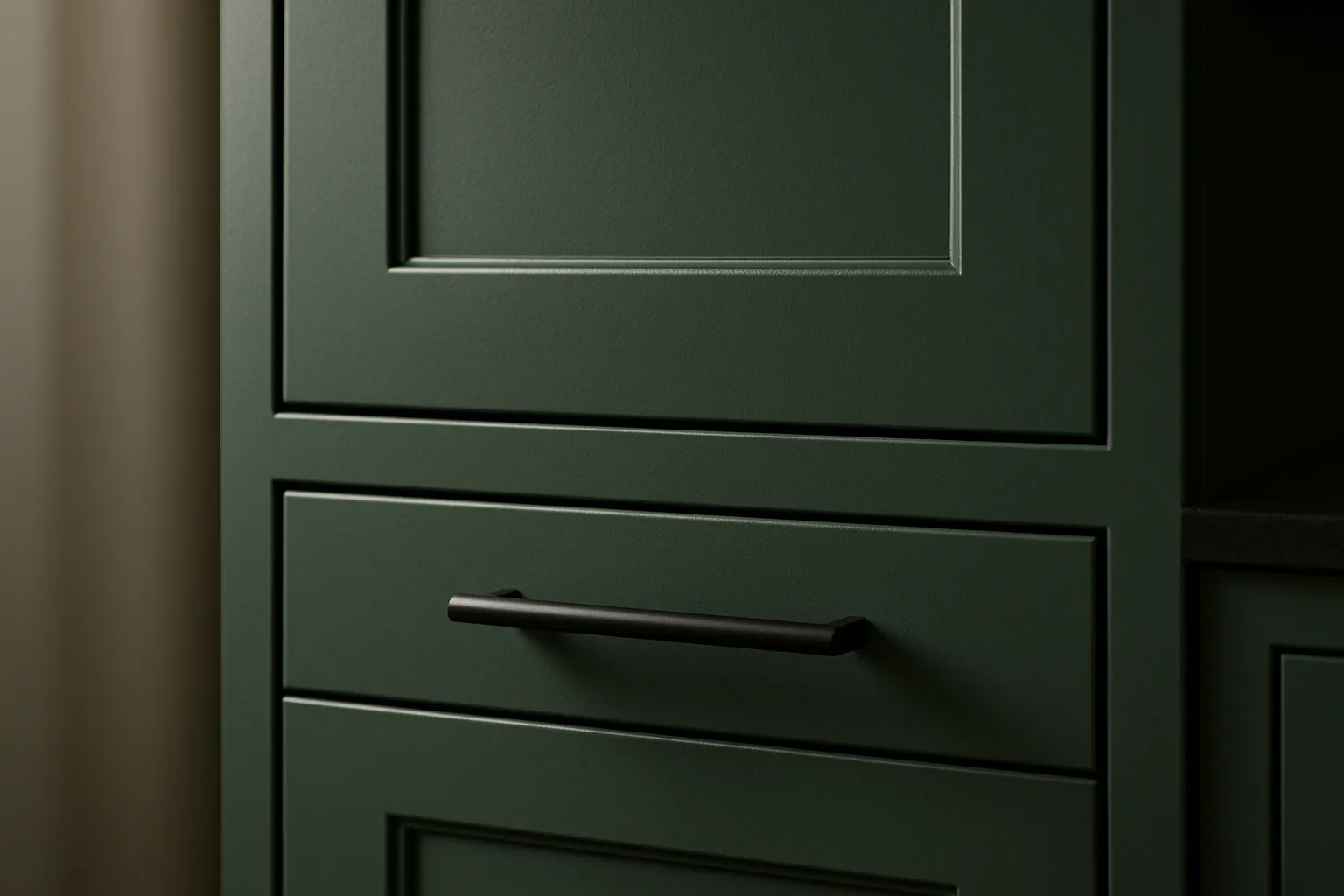
Modern Shaker typically means narrower rails and stiles, often 2 to 2.25 inches, for a cleaner, less busy face. The inside profile is usually a crisp square shoulder rather than a routed cove. Finishes lean toward flat and matte whites, warm greys, greiges, and increasingly deep inky blues and forest greens, often paired with a natural rift-cut oak island for contrast. Hardware either goes minimal (thin bar pulls, small knobs) or disappears entirely into integrated finger channels and edge pulls. The result reads contemporary while keeping the timeless bones that make Shaker resell well.
Materials That Hold Up in Real Kitchens
The door style is only half the story, what’s behind it determines how long the kitchen lasts. For the door and frame itself, solid hardwood (maple, oak, or paint-grade poplar) is the standard for durability and a clean paint finish. Many modern painted Shakers use an MDF center panel because it stays perfectly flat and won’t telegraph seasonal expansion lines through the paint the way solid wood sometimes can. That’s a feature, not a shortcut, for a smooth painted look.
For the cabinet box, we build with 3/4-inch plywood rather than particleboard. Plywood holds screws and hinges better, resists moisture around dishwashers and sinks, and simply weighs and feels more solid, which matters in a region where kitchens see hard daily use and homes hold their value. Drawer boxes should be solid wood with dovetail joinery, not stapled butt joints or plastic. These are the details that separate a cabinet that looks good on install day from one that still closes square in fifteen years.
Hardware and Function: Where the Money Is Well Spent
Modern Shaker’s clean face invites you to invest in the movement behind it. Soft-close, six-way adjustable hinges are the baseline, they eliminate slamming and let installers dial doors into perfect alignment. Full-extension, soft-close undermount slides let drawers open completely so you can reach the back of a deep pot drawer without kneeling on the floor.
Beyond the basics, this is where a kitchen earns its keep: deep drawer banks instead of base cabinets with doors, pull-out trash and recycling, a tray divider next to the oven, and a corner solution like a LeMans or magic-corner unit that recovers otherwise-dead space. Because Bay Area kitchens are often smaller and command premium square footage, function-per-inch matters more here than in many markets. Spending on smart storage inserts almost always beats spending on decorative trim you’ll stop noticing after a week.
Custom, Semi-Custom, or RTA: Choosing for Your Project
Modern Shaker is available at every tier, and the right choice depends on your kitchen’s constraints. Ready-to-assemble (RTA) cabinets come in fixed sizes and finishes; they’re the budget path and can work for a rental or a perfectly rectangular room, but odd walls, tall ceilings, and specific color matches expose their limits. Semi-custom widens the size and finish menu and adds storage options. Full custom lets you match an exact paint color, build non-standard depths and heights, and fit around the bay windows, angled walls, and older-home quirks common in San Francisco and Peninsula houses.
Because we manufacture locally in San Jose, our custom and semi-custom modern Shaker orders run roughly a three-week lead time rather than the two to three months typical of overseas custom lines, and if a panel needs adjusting after templating, it’s a short drive, not an international reorder. Local building also means our quality control and warranty support are handled by the same team that built the cabinets, which shortens the path when a homeowner or builder needs something addressed.
FAQ
Q1: Are white modern Shaker cabinets going to look dated in a few years?
A1: Shaker has stayed in demand for over a century precisely because it isn't tied to one era. A clean white or warm off-white modern Shaker is close to timeless. If you want insurance against trends, keep the perimeter neutral and use color or wood tone on an island, which is easy to refinish or replace later.
Q2: Should the center panel be solid wood or MDF for a painted Shaker?
A2: For a painted finish, an MDF center panel is often the better choice because it stays flat and resists the hairline seasonal movement lines that can show through paint on solid wood. Solid wood is preferred for stained finishes where you want visible grain. The frame itself is typically solid hardwood in both cases.
Q3: What's the real difference between plywood and particleboard boxes?
A3: Plywood is layered wood veneer that holds screws and hinges tightly, resists moisture near sinks and dishwashers, and stays square over time. Particleboard is cheaper and heavier but can crumble at fasteners and swell if it gets wet. We build boxes in 3/4-inch plywood for durability and long-term value.
Q4: How long does a custom modern Shaker kitchen take in the Bay Area?
A4: Because we manufacture in San Jose, most custom and semi-custom orders run about three weeks, versus the two to three months common with overseas lines. Local production also means faster fixes and warranty support if anything needs adjusting after templating or install.
Q5: Can I get handleless modern Shaker cabinets?
A5: Yes. A truly handleless look uses integrated edge pulls, finger channels, or a slim recessed grip machined into the door edge, paired with push-to-open or touch-latch hardware. It's a clean contemporary option, though thin bar pulls remain popular for their everyday ease of grip.
Q6: Is modern Shaker a good fit for a small San Francisco kitchen?
A6: It's one of the best fits. The flat, low-profile face reads clean and doesn't visually crowd a tight room, and custom sizing lets us build around the angled walls and non-standard dimensions common in older SF and Peninsula homes. Pair it with full-extension drawers and corner storage to maximize every inch.